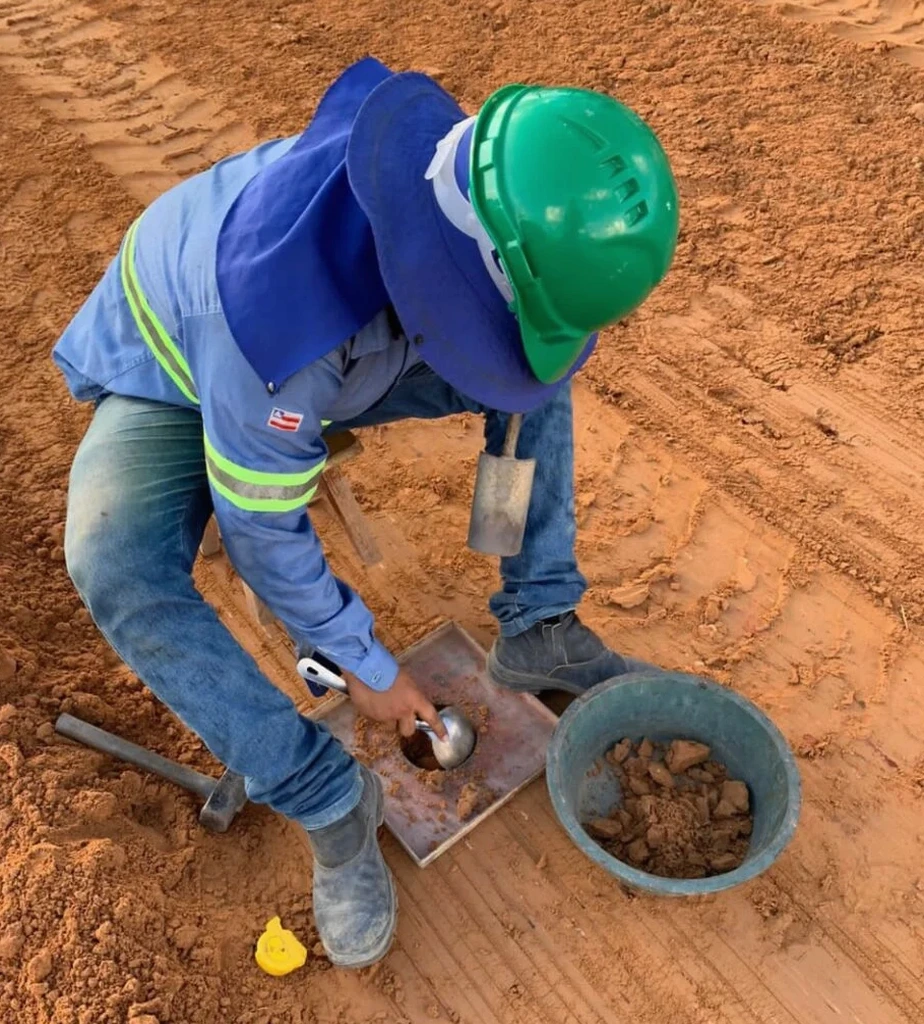
Austin's footprint has doubled since the tech boom of the early 2000s, and every new campus, bridge approach, and residential subdivision sits on a geological boundary that runs right through the city. West of the Balcones Fault you get shallow limestone with thin clay veneers; east of I-35 you hit the Blackland Prairie, where fat clays can swing from rock-hard to slick mud in one rain event. That split makes compaction verification non-negotiable. We run the sand cone field density test per ASTM D1556 because it gives you a direct number that no nuclear gauge reading can argue with. The method is low-tech but brutally honest: a calibrated sand, a base plate, and a hole that tells the truth about what the roller actually achieved. For deep utility trenches in the Eastern Crescent, we often pair the sand cone check with a Proctor curve to confirm that the lab maximum dry density still matches the borrow source being placed that week.
A sand cone test gives you a direct volume and a direct mass. There is no calibration curve between the result and the truth.
Methodology and scope
Local considerations
In West Austin, a foundation pad cut into the Glen Rose limestone can meet density on the first pass with a sheepsfoot roller because the weathered marl breaks down into a well-graded fill. Over in the St. Johns neighborhood, the same spec on a pad built over Blackland Prairie clay may require three roller patterns and a moisture adjustment window because the clay lumps hold air voids like a sponge. The risk of skipping a field density check is not theoretical: we have cored slabs in Mueller where the subgrade tested fine at the surface with a dynamic cone but failed the sand cone at 12 inches because the bottom lift was fluffed by backfill settlement. The city of Austin requires a minimum of one test per 1,500 square feet per lift on commercial pads, and utility trench testing every 50 linear feet for water and wastewater lines, with tighter spacing on fire line backfill. When the test fails below 95 percent of the lab maximum, the contractor re-compacts and we retest, but the bigger cost is the delay: a failed lift on a Friday afternoon can stall the pour until Monday, and in a city adding 180 people a day, that schedule hit compounds fast.
Regulatory framework
The testing adheres to ASTM D1556-15e1 (Standard Test Method for Density and Unit Weight of Soil in Place by Sand-Cone Method), AASH
Other technical services
Field Density Verification Package
Full-day deployment with two-person crew, calibrated Ottawa sand kit, on-site moisture determination, and GPS-tagged test reports delivered by 7 PM. We coordinate directly with the grading foreman so test locations are pre-marked and the roller stays moving.
Proctor Correlation and Borrow Source Check
When the fill material changes or the lab curve looks suspicious, we run a one-point Proctor check on the same soil from the sand cone hole. This catches shifts in optimum moisture before the failing density test happens, saving rework on large pads and linear trench runs.
Typical parameters
Frequently asked questions
How much does a sand cone density test cost per point in the Austin area?
What is the difference between a sand cone test and a nuclear density gauge for Austin clay soils?
The sand cone gives you a direct measurement of soil volume and mass, which is then corrected for moisture in the lab. A nuclear gauge estimates density indirectly by counting backscattered photons or gamma rays and relies on a calibration curve that may not represent the specific mineralogy of Blackland Prairie clays. On highly plastic soils like Houston Black clay, the nuclear gauge can overestimate density when the soil is wet and underestimate it when the soil is dry, while the sand cone removes that ambiguity.
How many sand cone tests does the City of Austin require for a commercial building pad?
The City of Austin typically requires a minimum of one field density test per 1,500 square feet per compacted lift, with additional tests specified by the geotechnical engineer of record if the soil variability is high. Utility trench backfill generally requires tests every 50 linear feet, and fire line trenches often need tighter spacing. We always verify the current project specifications and city inspector expectations before starting the day's testing schedule.
Can the sand cone method be used in granular base course under a concrete slab?
Yes, and it is actually the preferred method for open-graded base course where a nuclear gauge can give erratic readings due to the air voids. The limitation is particle size: ASTM D1556 is suitable for soils with a maximum particle size of about 1.5 inches. For base course with larger aggregate, we use a replacement method with a larger ring and calibrated gravel, but for standard TxDOT Type A or Type D base under slabs, the sand cone works reliably.