A contractor called us last August from a site off South Lamar. They'd been rolling the same structural fill for three days and still couldn't hit 95 percent compaction. The material was Eagle Ford shale, slightly weathered, and the moisture was swinging three points between morning and noon. We ran a Modified Proctor on the actual borrow source instead of the generic classification they'd been using, and the optimum moisture shifted enough to change the whole placement window. That's what Proctor testing in Austin usually comes down to: matching the lab curve to the real geology, not just checking a box on the spec sheet. Whether it's a Standard Proctor for landscape berms or Modified for a Williamson County roadway, the sand cone density field check only means something if the lab reference is dialed in to the native formation, and that's where a lot of earthwork goes sideways.
A Proctor curve matched to the wrong compactive effort isn't just a lab error—it's a guaranteed compaction failure in the field.
Methodology and scope
Local considerations
Austin's growth since the 1990s has pushed development onto terrain that fifty years ago nobody would have built on: expansive clay slopes west of MoPac, filled quarries in Round Rock, and thin soil veneers over pinnacled limestone in the Hill Country. A Proctor test done on a bulk sample from the site next door won't necessarily represent what your excavator is cutting into. We've seen projects where the borrow source changed twice during rough grading because the contractor hit a lens of fat clay with plasticity over 40, and the original moisture-density curve was developed on lean clay with a PI of 15. The result was a month of rework, multiple failing nuclear density tests, and a structural fill that had to be moisture-conditioned with a disc harrow and re-rolled. When the Proctor reference is wrong, every field density test becomes a moving target. For deep fill sections over 8 feet, we routinely recommend Modified Proctor regardless of the structural loading, simply because the self-weight of the fill demands compactive effort that Standard Proctor doesn't simulate. The triaxial shear test sometimes gets specified alongside Proctor when the fill will carry significant structural load, because density alone doesn't guarantee shear strength.
Regulatory framework
ASTM D698-12: Standard Test Methods for Laboratory Compaction Characteristics of Soil Using Standard Effort, ASTM D1557-12: Standard Test Methods for Laboratory Compaction Characteristics of Soil Using Modified Effort, and TxDOT Tex-113-E: Laboratory Compaction Characteristics and Moisture-Density Relationship of Subgrade, Embankment, and Backfill.
Other technical services
Standard Proctor (ASTM D698) for light-duty fill and landscape grading
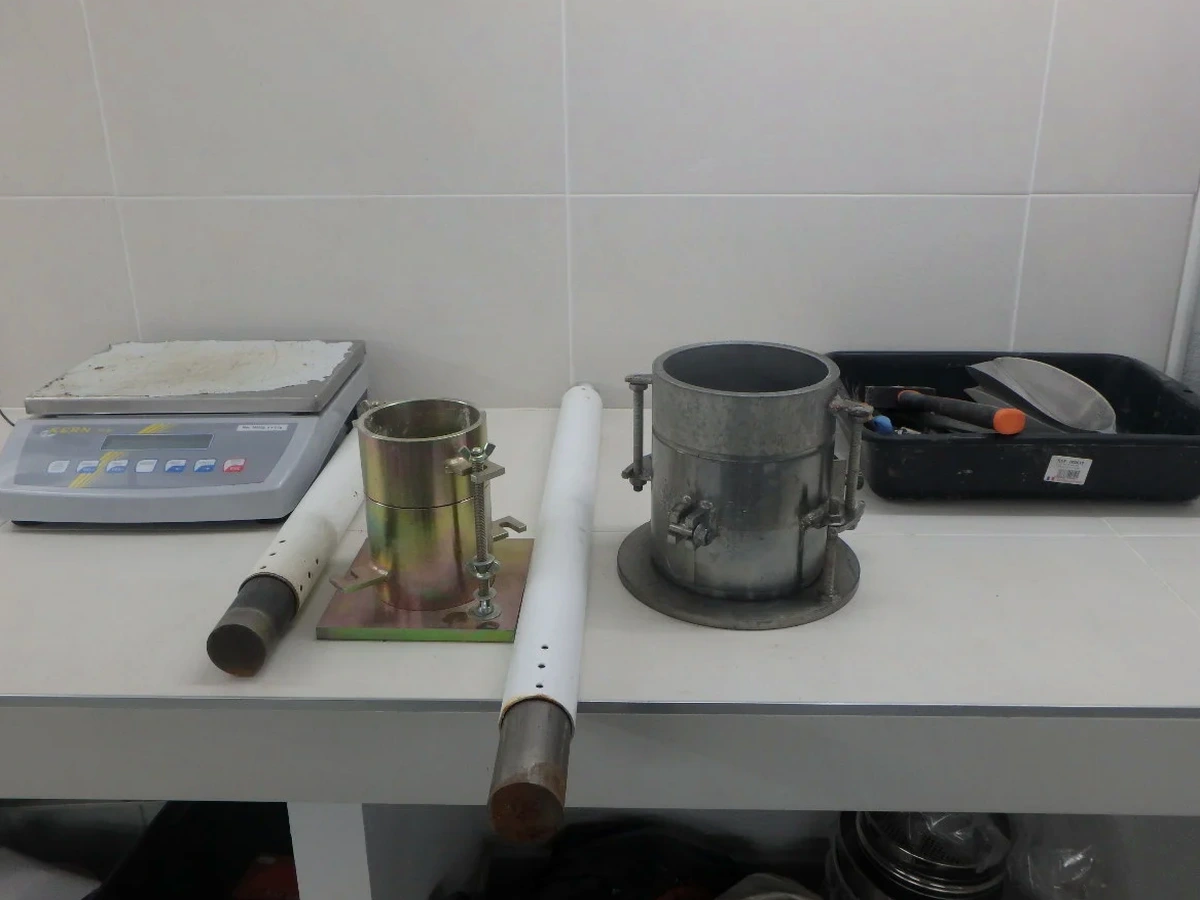
We compact material in a 4-inch mold using a 5.5-lb hammer dropped 12 inches, three layers at 25 blows each. This method suits trench backfill, landscape berms, and non-structural fill where compaction equipment is limited to walk-behind rollers or plate compactors.
Modified Proctor (ASTM D1557) for structural fill and pavement subgrade
Using a 10-lb hammer dropped 18 inches across five layers, this test replicates the energy of heavy vibratory rollers on TxDOT roadways, building pads, and deep fill sections. The resulting curve drives field density acceptance for 95% or 98% standard Proctor maximum dry density.
Typical parameters
Frequently asked questions
How much does a Proctor test cost in Austin?
When should I use Modified Proctor instead of Standard Proctor?
Standard Proctor is appropriate for landscape fills, utility trenches, and lightly loaded slabs where compaction equipment is relatively light. Modified Proctor applies to structural fill under foundations, pavement subgrade, and any fill exceeding about four feet in thickness. The rule of thumb we use in Austin: if a loaded dump truck or a Cat D6 will be driving on it, run Modified.
How long does a Proctor test take in the lab?
A full moisture-density curve with five compaction points takes one to two working days, mostly because the sample needs to cure at each moisture increment before weighing. A one-point check against an existing family of curves can often be turned around within 24 hours. We always oven-dry the moisture samples overnight rather than using a speedy moisture meter, because the clay fractions in Austin soils release water slowly and a rushed moisture content will shift the whole curve.
Can you run a Proctor on material with gravel and rock fragments?
Yes, but the standard 4-inch mold is limited to material passing the 3/4-inch sieve. If more than about 10 percent of the sample is retained on the No. 4 sieve, we apply the rock correction procedure from ASTM D4718 to adjust the maximum dry density. For material with significant oversize, we can run the test in a 6-inch mold per ASTM D1557, but that requires a larger sample mass and we'll coordinate with your field crew to get enough material from the borrow source.