Austin's population has surged past 975,000, pushing construction onto the challenging terrain of the Edwards Plateau and the Balcones Fault Zone. This rapid expansion means engineers regularly confront 20-foot cuts in Eagle Ford shale or deep excavations near Walnut Creek, where soil cohesion can shift dramatically within a few hundred feet. In our experience supporting projects across Travis County, we've seen how a well-designed anchor system transforms a structurally marginal retaining wall into a resilient, long-term solution. The interaction between anchor bond zone and Austin's interbedded limestone and expansive clay layers requires a design approach rooted in site-specific soil investigation and careful evaluation of the groundwater regime.
Anchor capacity in Austin's karst limestone often hinges less on grout strength and more on the geometry and roughness of the bond zone within solution-enlarged fractures.
Methodology and scope
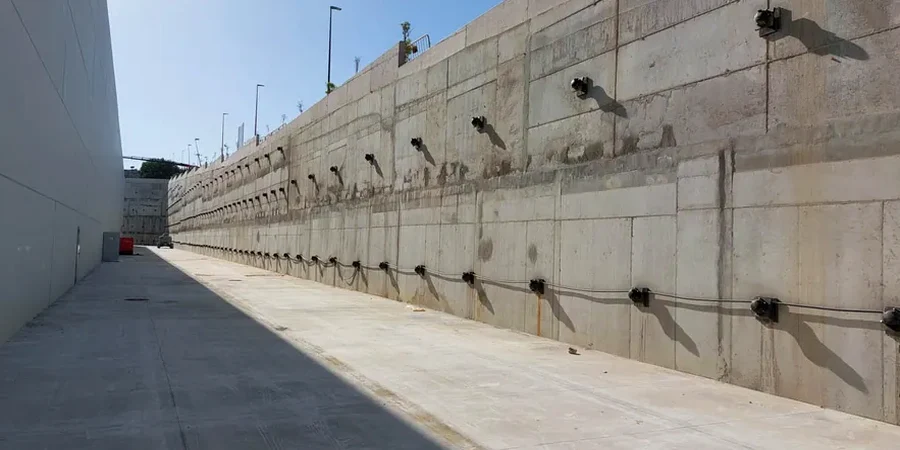
Local considerations
Austin's eastward expansion since the 1990s has pushed development onto deep deposits of Blackland Prairie clay, a soil formation notorious for its shrink-swell behavior that generates lateral pressures far exceeding at-rest earth pressure coefficients. We have investigated several anchored retaining walls in the Mueller redevelopment area where seasonal desiccation cracks allowed water infiltration directly into the bond zone, accelerating tendon relaxation. Without a thorough slope stability analysis integrated with the anchor design, even a code-compliant wall can experience progressive deformation if the global failure surface extends beyond the reinforced block. The combination of high-plasticity clays and Austin's flash-flood hydrology creates a scenario where drained and undrained loading conditions must both be evaluated explicitly for the anchor free length.
Regulatory framework
PTI DC35.1-14 furnishes recommendations for prestressed rock and soil anchors.
Other technical services
Permanent Tied-Back Wall Design
Full design of prestressed anchors for permanent retaining structures, including evaluation of long-term creep in Taylor Marl, double-corrosion protection detailing per PTI DC35.1, and coordination of performance testing sequences.
Temporary Excavation Support Anchors
Design of removable and sacrificial anchors for soldier pile and lagging walls in urban Austin excavations, with staged load-transfer analysis considering adjacent foundation surcharge from historic masonry buildings.
Anchor Load Testing and Forensic Evaluation
ASTM D3689-compliant performance and proof testing programs, lift-off testing for existing anchors showing signs of distress, and forensic analysis of grout-to-ground bond failure in variable karst conditions.
Typical parameters
Frequently asked questions
How does Austin's expansive clay affect long-term anchor performance?
Expansive clays like the Eagle Ford and Taylor Groups can impose additional tensile loads on anchors during wet cycles if the wall restricts soil heave. Our designs incorporate a compressible zone behind the wall facing or specify an unbonded length that extends well beyond the active depth of seasonal moisture fluctuation, typically 10 to 15 feet in the Austin area, to decouple the anchor from these volume-change stresses.
What is the typical cost range for an anchor design package in Austin?
Do Austin building codes require proof testing for every anchor?
The City of Austin adopts the IBC with local amendments, which defers to PTI DC35.1 for grouted anchors. This standard mandates proof testing on a minimum of 10 percent of production anchors, but on sites with highly variable karst conditions, we typically recommend increasing that proportion to 25 percent and including at least one sacrificial performance test anchor per distinct soil/rock unit to verify the design bond stress assumptions.
How do you account for Austin's seismic hazard in anchor design?
Austin sits in a relatively low seismic hazard region, but ASCE 7-22 still requires evaluation of a pseudo-static seismic coefficient (kh) for anchored walls. We apply a Mononobe-Okabe analysis modified for the specific site class—typically Site Class C or D in Austin—and check that the anchor free length extends beyond the seismically enlarged active wedge. For critical structures, we also evaluate the potential for strength loss in saturated granular lenses within the limestone during cyclic loading.