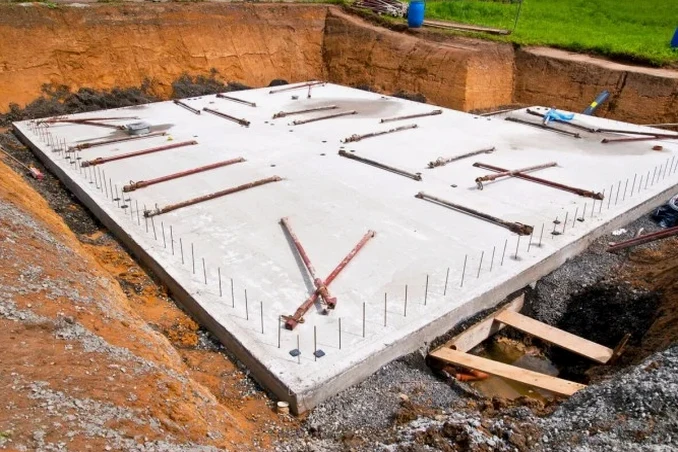
A mixed-use project off South Lamar kept getting the same recommendation from every geotech on the shortlist: raft foundation design in Austin. The developer had high hopes for a five-story structure but the soil profile was classic east Austin — stiff clay over weathered limestone, with moisture-sensitive layers that shift between dry summers and flash-flood months. We ran a full drilling program and confirmed what everyone suspected. Strip footings would have required over-excavation down to eight feet in some spots, and even then differential movement was a real concern. The structural engineer needed uniform bearing and crack control across a slab that doubled as the parking level. That job still runs through our minds when new clients ask whether a raft foundation is overkill for a mid-rise. In this city the answer usually surprises them.
Austin’s variable bedrock depth and expansive clay seams make raft foundation design a settlement-control exercise more than a bearing-capacity problem.
Methodology and scope
Local considerations
The mistake we see contractors make again and again is treating a raft foundation like a thickened slab-on-grade and skipping the soil-structure interaction analysis. In Austin that’s a gamble that shows up fast. When the clay swells under one corner and the limestone stays rigid under another, the mat cracks in a pattern that’s expensive to repair and nearly impossible to hide from a buyer. Another error is ignoring buoyancy. Projects near the river or along Barton Creek sit on a water table that rises sharply after heavy rain. A raft that wasn’t checked for uplift can heave or float, and by then the slab has already separated from the columns. The fix isn’t cosmetic. It’s structural demolition and a lawsuit. A proper geotechnical investigation that feeds real ks values and moisture-condition profiles into the raft design is the only way to sleep at night on these sites.
Regulatory framework
The design of raft and mat foundations in Austin, Texas, shall adhere to ACI 336.2R-23 for analysis and design of combined footings and mats, IBC 2024 with ASCE 7-22 Chapter 18 for soils and foundations, and ASTM D2487-17 for soil classification in engineering applications.
Other technical services
Geotechnical investigation for mat foundation design
Borings, sampling, and lab testing to establish bearing capacity, swell potential, and bedrock depth for raft analysis.
Soil-structure interaction modeling
Winkler-spring and continuum models calibrated with field-derived subgrade modulus for flexible or rigid mats.
Construction-phase support in Austin
Subgrade inspection, proof-rolling, and moisture-condition verification before the mat pour.
Typical parameters
Frequently asked questions
What does raft foundation design in Austin cost for a typical commercial building?
When is a raft foundation recommended over isolated footings in Austin?
We recommend a raft when the bearing stratum is deeper than about 6 feet across more than half the footprint, when expansive clay layers are thick enough to cause differential heave, or when the column loads are heavy enough that isolated footings would overlap. In Austin’s east and central corridors those conditions are common.
How do you handle the expansive clay under a mat foundation in Austin?
In our experience the best approach combines a moisture-conditioned subgrade with a underslab vapor barrier and, in severe cases, a void form system or deep undercut to remove the active clay zone. We also specify perimeter drainage to keep water from ponding against the slab edge, which is critical during Austin’s rainy spring months. More info.