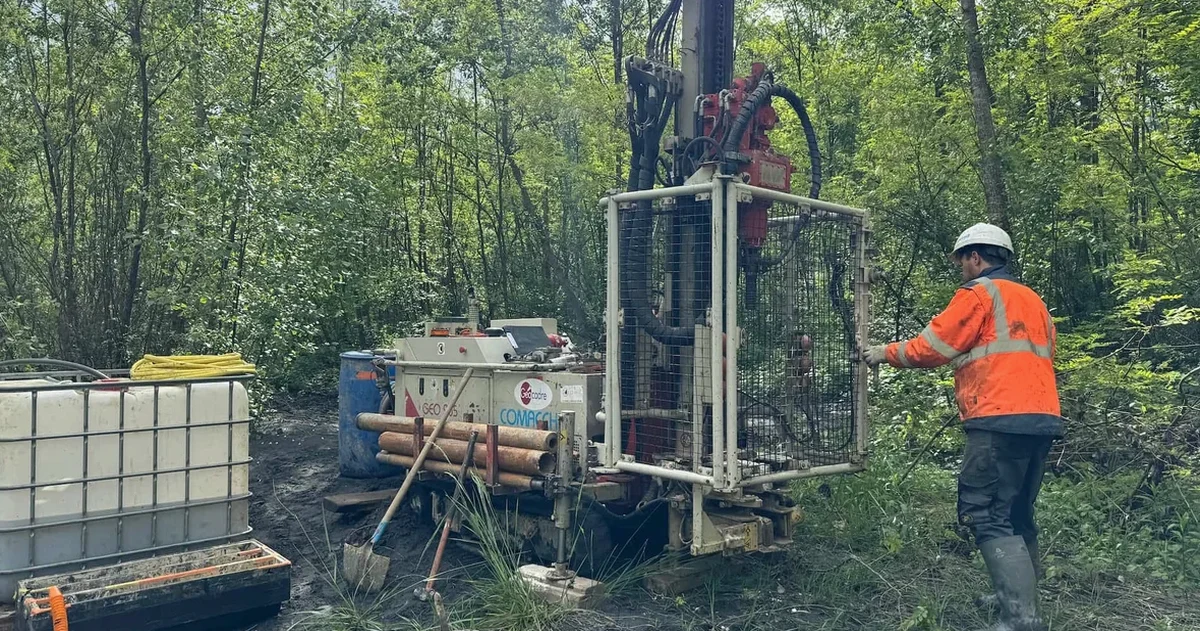
The drilling rig arrives on site and the first Shelby tube goes into the ground just west of MoPac, pulling up that classic Austin clay, dark and stiff. We run the soil mechanics study right there in the field van: pocket penetrometer, torvane, visual classification per ASTM D2488. The limestone is never far away, sometimes at three feet, sometimes at thirty. In our experience across the Balcones Fault Zone, the soil profile can flip completely within a single lot. That's why we pair the field logging with triaxial testing when the project has basement levels or significant column loads, because the undrained shear strength of the Eagle Ford formation varies dramatically with moisture content. We see it every week: a builder gets a preliminary report from a driller, but without the engineering parameters like effective friction angle and consolidation indices, the foundation design is just guessing. Our lab on the east side handles the full suite, from grain size distribution to swell pressure, because in Austin you're not designing for average soil, you're designing for the worst-case expansive scenario that happens right after a summer drought breaks.
In Austin, you don't design for average soil; you design for the expansive scenario that hits after a drought breaks.
Methodology and scope
Local considerations
IBC Chapter 18 and ASCE 7 set the baseline, but Austin's Site Development Code adds another layer because of the Critical Environmental Features overlay that protects recharge zones and karst features. The main risk we document in every soil mechanics study is differential movement: one corner of the slab sits on stiff marl, the other on highly expansive clay that swells three inches when wetted. That differential can tear a post-tensioned slab if the geotechnical parameters aren't correctly applied. The second risk is karst collapse west of the Balcones Escarpment, where solution cavities in the Edwards Limestone can open up during construction, suddenly swallowing rigs or excavators. We've mapped voids using resistivity and verified them with borings enough times to know that a desk study alone won't catch them. Sulfate attack on concrete is a third concern in the eastern part of the city, where pyrite weathering in the Austin Chalk formation produces sulfate levels that require Type V cement or special mix designs. The engineering logic is straightforward: characterize the ground honestly, parameterize the soil correctly, and give the foundation designer a report that anticipates the worst the Central Texas climate can throw at it.
Regulatory framework
The relevant standards and codes include ASTM D2487-17e1 for Unified Soil Classification, ASTM D4546-21 for Swell/Collapse Potential, ASTM D2850-15 for Unconsolidated-Undrained Triaxial testing, IBC 2021 Chapter 18 for Soils and Foundations, and ASCE 7-22 for Site Classification.
Other technical services
Foundation Parameter Determination
We quantify allowable bearing capacity, modulus of subgrade reaction, and skin friction for drilled piers or footings. Includes swell pressure testing and consolidation analysis for the specific clay unit encountered on your site.
Pavement Subgrade Characterization
For streets, parking lots, and heavy industrial slabs, we run the Hveem or Texas triaxial class test (Tex-117-E), sulfate levels, and lime stabilization curves. The goal is a pavement section that won't pump or heave within the design life.
Typical parameters
Frequently asked questions
What is the typical cost range for a soil mechanics study in Austin?
How deep do you need to drill to satisfy Austin's building permit requirements?
The City of Austin typically requires borings to extend to a depth of at least twice the width of the foundation below the proposed bearing elevation, or to refusal on competent rock. In practice, we drill 20 to 30 feet in the clay formations and deeper if piers are planned. The exact depth is determined by the structural engineer's requirements and the subsurface conditions encountered during drilling.
What lab tests are mandatory for expansive soils in Austin?
Atterberg limits (liquid limit, plastic limit, plasticity index) are the starting point. When the PI exceeds 25, we add swell-consolidation tests per ASTM D4546 to quantify swell pressure and percent swell under specific confining loads. The structural engineer needs these parameters to calculate the required beam depth and steel reinforcement for a post-tensioned slab on grade.
How do you handle karst features west of the Balcones Escarpment?
In karst-prone areas of western Austin, we combine standard borings with geophysical methods like electrical resistivity or MASW to map voids and dissolution features. If anomalies are detected, we target them with additional borings or probe holes to define the limits of the void or soft zone. The report includes recommendations for bridging, filling, or avoidance depending on the size and depth of the feature.